The New York State Mold Remediation Process, Explained
Key Takeaway
In New York, any mold project over 10 square feet legally requires two separate companies: one licensed assessor to inspect and write the remediation plan, and one licensed remediation contractor to do the cleanup. The assessor returns at the end to verify the work. This article explains why the law works that way, what each step costs, what documents you should receive, and the questions homeowners ask most.
Found mold in your home in New York and not sure what happens next? The state has a specific legal process for it, written into the Labor Law in 2016, and most homeowners have never heard of it until they need it. Call KPM Restoration at (518) 859-9769 for a free consultation, or read on. We’re a NYS Licensed Mold Remediation Contractor serving the Capital Region and Hudson Valley, and we walk homeowners through this process every week.
Here’s the short version: in New York, you hire two separate companies for any mold project over 10 square feet. One inspects and writes the plan. The other does the cleanup. The first one comes back at the end and verifies the work. That’s the whole law in three sentences. The rest of this article explains why it works that way, what each step costs, and the questions our customers ask most often.
Quick navigation
- Why New York has a mold law in the first place
- Step 1: Hire a licensed mold assessor
- Step 2: The Mold Remediation Plan
- Step 3: Hire a licensed mold remediation contractor
- Step 4: Containment, removal, and cleanup
- Step 5: Clearance testing and the passed clearance report
- How to verify a contractor is licensed
- What it costs and how long it takes
- What documents you should receive
Why New York has a mold law in the first place
Before 2016, anyone with a shop vac and a business card could call themselves a “mold expert.” After Superstorm Sandy in 2012, thousands of Long Island and NYC homeowners got hit with the same scam: one company would show up, “test” for mold, declare a toxic emergency, and then sell the homeowner a $20,000 cleanup. Same company, same job, no oversight.
New York responded with Article 32 of the New York State Labor Law, the country’s first statewide mold licensing law. It took effect January 1, 2016 and is enforced by the New York State Department of Labor. The law has three parts: training, licensing, and minimum work standards.
The most important part of the work standards is also the part that confuses homeowners the most: a single company is not allowed to perform both the assessment and the remediation on the same property. That’s the rule that protects you, and we’ll keep coming back to it.
The two-license rule, in plain English: The company that tells you how bad the mold is can’t also be the one you pay to clean it up. They have to be separate businesses with separate ownership.
The exact statutory language is in NY Labor Law §936: “No person shall own an interest in both the licensee who performs mold assessment services and the licensee who performs mold remediation services on the same property.” The penalty for getting caught violating it can run from $800 to $10,000 per violation, plus license revocation, depending on which authority is enforcing it.
Step 1: Hire a licensed mold assessor
A mold assessor is the inspector. Their job is to figure out what you’ve got, what’s causing it, and what it’ll take to clean up. In New York, they have to hold a Mold Assessor License from the Department of Labor, valid for two years and renewed with continuing education.
When you call an assessor for the first time, expect them to:
- Walk through the affected areas with you and document what they find
- Use a moisture meter to find hidden water sources behind walls and under floors
- Identify the underlying cause of the moisture (roof leak, plumbing failure, condensation, grading, etc.)
- Decide whether mold sampling is actually needed (more on that below)
- Educate you about the law and what comes next
A good assessor in the Hudson Valley or Capital Region will charge somewhere between $400 and $900 for a residential inspection, depending on the size of the property and whether sampling is involved.
A note on mold sampling
Most homeowners assume the assessor is going to take a bunch of swabs and send them to a lab. They usually don’t, and the state actually discourages it. The Department of Labor’s official position is that sampling is rarely useful because there are no national or state standards for what counts as “too much” mold, and sampling almost always finds some mold (it’s everywhere: outdoors, indoors, on your skin right now). Sampling has a place, mostly when occupants have a documented allergy to a specific species, but a good assessor won’t sell it to you by default.
What you actually need from the assessor is the next thing.
Step 2: The Mold Remediation Plan
This is the document that drives the rest of the project. By law, the assessor has to give you a written Mold Remediation Plan before any cleanup can start. It’s specific to your property and your project, and it has to include:
- A description of the rooms and areas where remediation will be performed
- An estimate of how much material will be cleaned or removed (e.g., “100 square feet of drywall in the basement”)
- The specific abatement methods to be used in each area
- Containment requirements (plastic barriers, negative air pressure, HEPA filtration)
- Required personal protective equipment for the workers
- Clearance criteria, meaning how the assessor will verify the work was successful
- An estimate of cost and time for completion
- Information on any EPA-registered disinfectants or antimicrobials being considered
- The underlying source of moisture and what type of contractor can fix it
That last bullet is the one homeowners overlook. If you don’t fix the moisture source, the mold will come back. Every time. Roof leak, plumbing leak, grading issue, condensation on cold pipes: whatever the cause is, it has to be repaired before or during remediation. Mold remediation contractors aren’t legally required to fix the moisture source themselves (most don’t have the right trade licenses), but the plan will tell you what kind of contractor you need.
The Mold Remediation Plan is your legal protection. Once you have it, you can bring it to a licensed remediation contractor for an estimate, and the contractor will price the exact scope the assessor wrote, not a scope they made up themselves. That’s the second thing the law does for you that the old system didn’t.
Step 3: Hire a licensed mold remediation contractor
This is where KPM Restoration comes in. A Mold Remediation Contractor holds a separate license from the Department of Labor and employs licensed Mold Abatement Workers to do the physical work. We follow the assessor’s plan exactly. We don’t write the plan, we don’t get to argue with the plan, we don’t get to skip steps in the plan. That’s the law.
When you give us your Mold Remediation Plan, we’ll:
- Visit the property and confirm we can do the work as written
- Provide a detailed quote that maps line-by-line to the plan
- Coordinate with whoever is fixing the moisture source (our water damage restoration crews can do most of that work in-house, or we’ll recommend a plumber or roofer for what we don’t)
- Schedule the work around your assessor’s clearance availability
A lot of homeowners ask us to recommend an assessor before they’ve hired one. We can. We work with several independent licensed assessors across the Capital Region and Hudson Valley and we’ll give you a few names. We just can’t be one of them. By law, by ethics, and because we want to keep our license.
What “two separate companies” actually means
It’s not enough that the assessor and remediator have different names on the truck. Per §936, no person can own an interest in both the assessment licensee and the remediation licensee on the same property. That’s the legal line. The point is that the company writing the scope and the company performing the work shouldn’t share ownership in a way that lets one of them control the other on the same job.
Legitimate operators take this seriously because the consequences are real. Lose the license, lose the business.
Step 4: Containment, removal, and cleanup
Here’s what actually happens on the job. Most residential projects take three to five days of active remediation work, give or take depending on scope.
Day 1: Containment
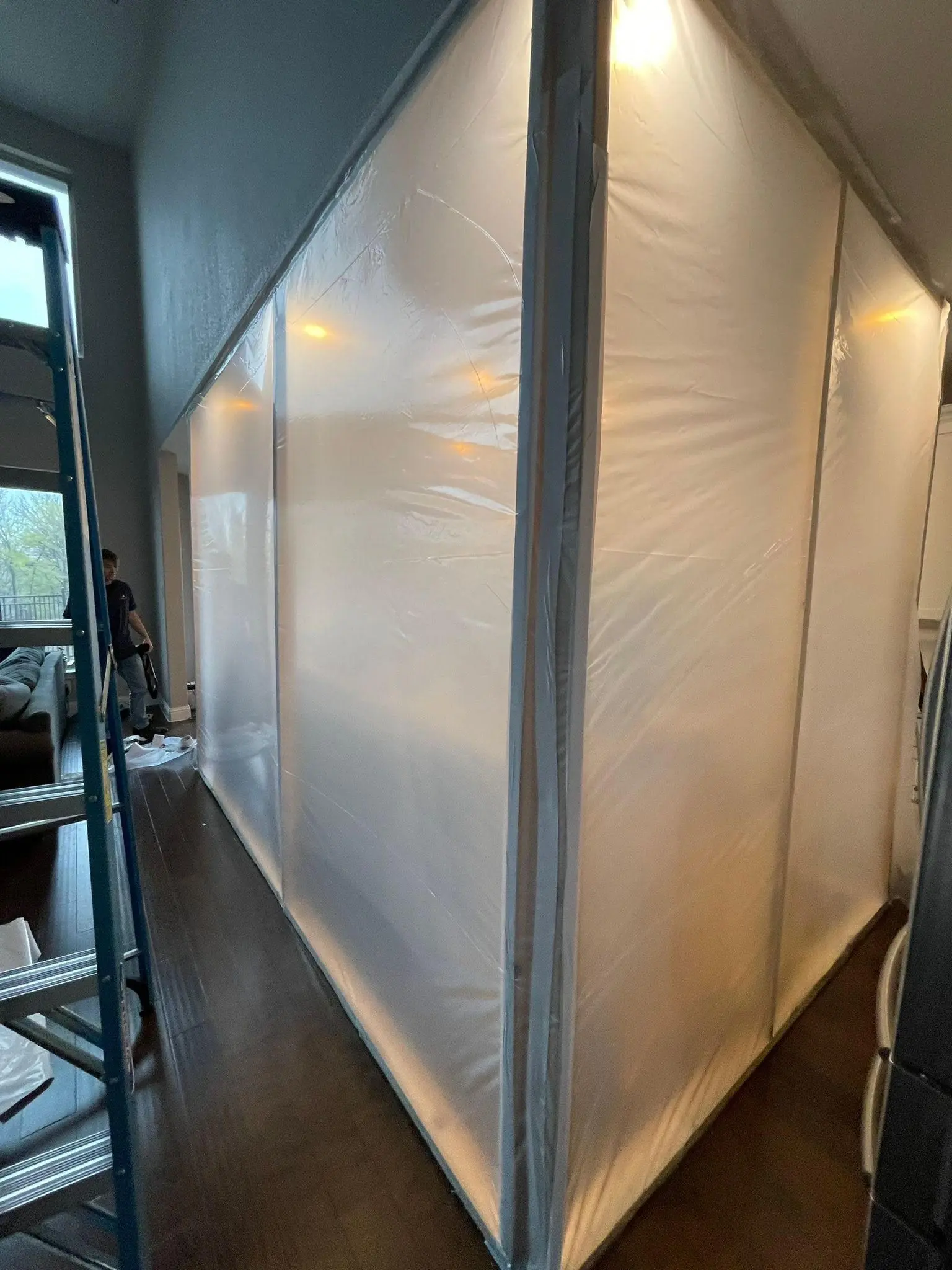
Before we touch any mold, we seal the work area off from the rest of your home. That means:
- 6-mil polyethylene sheeting taped to floor and ceiling at every entry point
- Negative air pressure inside the containment, maintained by HEPA-filtered air scrubbers
- Air locked entry/exit zones for workers
- Sealed HVAC vents in the affected area so spores don’t ride your ductwork to clean rooms
- Posted signage at every entrance, required by the law
Containment is the difference between a $4,000 mold job and a $40,000 cross-contamination disaster. Spores released without containment will travel through the entire house and you’ll be remediating bedrooms upstairs you never had to before.
Day 2–3: Removal and cleaning
Inside the containment, the work is straightforward but careful:
- Porous contaminated materials (drywall, insulation, carpet pad) come out and get bagged
- Non-porous surfaces (framing studs, subfloor, concrete) get HEPA vacuumed, then wet-wiped with antimicrobial
- Everything gets a second HEPA pass after drying
- An EPA-registered disinfectant gets applied if the assessor’s plan calls for it (and only if)
We document each step with photos for the assessor and for your records.
Day 4: Drying and pre-clearance prep
Before the assessor comes back, the area has to be visibly clean, fully dry, and ready for inspection. Containment stays up. We don’t pull the plastic until the assessor signs off.
Step 5: Clearance testing and the passed clearance report
Clearance testing is technically optional. New York doesn’t force you to have a post-remediation assessment, and if you decide to skip it, the assessor and contractor will document that you accepted the work as-is before they leave. That said, you’ll especially want clearance done if insurance is covering the project or if the property is part of a real estate deal. The passed clearance report is the document those parties will ask for.
The same assessor who wrote the plan should come back to verify the work. They don’t have to (you can use a different licensed assessor), but most homeowners use the original one because they already know the property.
The post-remediation assessment includes:
- Visual inspection inside the containment for any visible mold
- Verification that everything in the original plan was actually done
- Air sampling, if the plan called for it (most plans don’t, but some do)
- A check that the moisture source was addressed
If everything checks out, the assessor issues a written passed clearance report. The project is officially complete. Containment comes down. We schedule reconstruction (drywall, insulation, paint) at your convenience. Reconstruction goes after clearance, not before. Installing new drywall over an unverified remediation can cover up unresolved contamination, and you’ll find out the hard way.
If something failed (wrong materials missed, a spot of mold remaining, moisture source not fixed), the assessor issues a final status report instead, listing what still needs to happen. The remediation contractor is responsible for going back and fixing it. If the work was done according to plan and it still failed clearance, that’s on the contractor to make right at no additional cost to you. That’s another thing the law gets right.
How to verify a contractor is actually licensed
Both your assessor and your remediator should be able to give you a NYS Mold License number on request. You can verify any licensee in the state directly through the Mold Contractor Licenses dataset on the NY Open Data portal, published by the Department of Labor. It takes about 30 seconds. If a contractor can’t or won’t share their license number, that’s the entire conversation. Move on.
A few things to ask any company you’re considering, before you sign anything:
- “What’s your NYS Mold License number?”
- “Do you also perform mold testing or clearance for the same project?” (If yes, walk away.)
- “Will you give me the written remediation plan before work starts?”
- “If clearance fails because of something on your end, who pays for the rework?”
A licensed, ethical contractor answers all four without hesitation. KPM holds a Mold Remediation Contractor License under NYS Labor Law Article 32 and our technicians carry IICRC AMRT (Applied Microbial Remediation Technician) certifications.
What it costs and how long it takes
Real ranges, based on what we see across the Capital Region and Hudson Valley in 2026:
| Project size | Typical cost | Timeline |
|---|---|---|
| Small | $1,500–$3,500 | 1–2 days |
| Medium (basement walls, single room) | $3,500–$8,000 | 3–5 days |
| Large (multi-room, attic, finished basement) | $8,000–$20,000+ | 5–10 days |
| Add: Mold assessment | $400–$900 | 1 day on-site, 2–3 days for plan |
| Add: Clearance testing | $300–$600 | 1 day on-site, 1–2 days for results |
| Add: Reconstruction | Varies | Scheduled after clearance |
Insurance is a separate question. Homeowners policies generally cover mold only when it results from a covered peril like a burst pipe, and most policies cap mold coverage at $5,000 to $10,000 even then. Mold from gradual leaks, humidity, or maintenance issues is typically excluded. We help document the cause for insurance claims when there’s a defensible covered event.
One thing that changed in 2023: New York amended its Property Condition Disclosure Statement to require sellers of residential real estate to disclose known indoor mold conditions. If you’re remediating before a sale, hold onto your passed clearance report. It’s the document that proves the issue was professionally resolved and it can save the deal.
What documents you should receive
Keep a folder. By the time the project is finished, you should have all of the following:
- The mold assessment report from your licensed assessor, including their findings and any sampling results
- The written Mold Remediation Plan from the assessor, before any cleanup begins
- The Mold Remediation Work Plan from the contractor, before site preparation begins
- Photos of the work area at containment, mid-job, and at completion
- The post-remediation assessment report and a written passed clearance report from the assessor
- A reconstruction estimate if rebuild work is part of the project
These documents matter beyond the job itself. Insurance carriers ask for them. Real estate attorneys ask for them at closing. Future buyers’ inspectors ask for them. Tenants in landlord disputes ask for them. If a contractor finishes and walks away without leaving you documentation, you don’t have proof the work happened. Treat the paperwork as part of the deliverable, not an afterthought.
Get a free consultation
If you’ve found mold in your home in the Capital Region or Hudson Valley and want help thinking through next steps, call KPM Restoration at (518) 859-9769. We’re a NYS Licensed Mold Remediation Contractor with offices in Mechanicville, Albany, Schenectady, Queensbury, Colonie, Poughkeepsie, Newburgh, and Kingston. We can recommend independent licensed assessors and walk you through what to expect, at no charge.
We do the remediation. We don’t do the assessment. That’s how the law works, and that’s how we keep it honest.