
Mold Remediation in Danbury
Mold in Your Danbury Property?
From the Victorian worker housing of the Main Street Historic District and Germantown to the converted seasonal cottages along the Danbury arm of Candlewood Lake and Lake Waubeeka, Danbury's building stock spans more than a century of moisture exposure. The Hat City's 1880s wood-frame homes near the Still River corridor often hide colonies behind original plaster and in fieldstone basements, while post-WWII ranches and Capes across Mill Plain, Pembroke, and Hayestown sit on slabs and fill that wick humidity into finished basements. Padanaram Brook, Kohanza Brook, and the Still River keep year-round humidity high across the central city, feeding hidden growth in crawlspaces and behind paneled walls. KPM Restoration follows IICRC S520 mold remediation protocols and EPA guidance, with technicians who are IICRC certified and trained to OSHA-compliant safety standards.
Call Now (845) 780-3473Get Help Now
Trusted in Danbury & Beyond
Real, verified 5-star reviews from homeowners and businesses we've served.
“A pipe burst in the basement of our vacation home and we didn’t discover it for a few weeks. I was so upset because it smelled terrible and I didn’t think we would ever get rid of the stench but KPM was so comforting and easy to work with. They had everything cleaned up and looking and smelling better than it had before. They were respectful of our property, finished faster than I expected and I didn’t have to lift a finger. I cannot recommend them enough! Thank you KPM ❤️”
alyss3456
“KPM helped me with fire damage restoration at my residence. I found them to be very responsive, professional & efficient.”
Randall Kestiung
“I used KPM for water removal and water damage cleanup at my restaurant. They were quick and courteous. I highly recommend them!”
Nilda Milano
“KPM came out to my house after my basement started flooding. They were quick to respond to me and the cost was well worth the money. They not only identified the problem but they took care of the issue easily. It was a huge relief to get this taken of fast, with the holidays that were coming up. I 100% recommend this company!”
Linda Anderson
“I recently used KPM for water damage, they were quick to respond, friendly and clean up was fast. I would highly recommend them.”
Rod Whitby
“This is the second time we've used KPM Restoration. Once in second home in VT for mold removal, and now in our main residence in Dutchess County for water removal from our basement. They showed up at our house within a couple of hours of our call, extracted the water, and dried out the basement. A job well done. Thank you to Eric and the entire crew.”
Dewayne Blue
“I recently use KPM to help with damage due to a burst pipe. They were friendly, reliable, and professional through the entire process.”
MaryEllen Trocino
“I recently used KPM for a mold issue, they responded quickly and are very professional, I highly recommend them.”
Cynthia Siegrist
What to Know
Understanding Mold Growth
Connecticut Mold Remediation: IICRC and EPA Standards
Connecticut does not have a state-mandated mold remediation license. We follow the national industry standard (IICRC S520) and EPA mold remediation guidance, which together define proper protocols for containment, HEPA filtration, removal of affected materials, antimicrobial treatment, and post-remediation verification. Our technicians hold IICRC certifications including WRT (Water Damage Restoration) and AMRT (Applied Microbial Remediation). For documentation purposes, such as a home sale or insurance claim, we recommend hiring an independent mold inspector. We're happy to refer one and coordinate the work.
Mold in Danbury's Older Homes and Hat City Stock
The blocks around North Street, White Street, South Street, and Highland Avenue near the old Still River factory corridor hold a deep stock of 1880s and 1890s hat-boom Victorians, narrow Queen Anne two-families, and pre-war multifamily conversions in the dense downtown core. These properties often have fieldstone or block basements that wick moisture year-round, original plaster walls that hide growth behind them, and original subfloors where mold spreads unseen. A handful of even older colonial-era structures in the historic district carry stone foundations with the same vulnerabilities. We use thermal imaging and moisture meters to find hidden colonies, then contain and remove them without contaminating the rest of the building.
Lake and Lake-Adjacent Mold
Along the Danbury shore of Candlewood Lake and around Lake Waubeeka in the southern part of the city, many homes started as summer-only cottages and were converted to year-round use from the 1950s onward. They typically have crawlspaces, minimal insulation, and older plumbing on lots sized for seasonal living, which means recurring water intrusion and humidity the structures were never built to handle. The result is ideal conditions for hidden mold in crawlspaces, behind paneled walls, and in spaces that stay damp through the warm months. We scope these losses with thermal imaging and moisture meters before any demo to make sure the remediation captures the full footprint.
Commercial Mold in Danbury's Office and Industrial Stock
Mold issues in Danbury's commercial buildings often surface around HVAC equipment, behind chronic-leak walls, in tenant-improvement build-outs that trapped moisture, and in basement and mechanical-room spaces. The Danbury Fair Mall corridor along the Still River and Lake Kenosia, downtown professional offices near Main and White Streets, and the redeveloped hat-factory mill buildings along the river all create exposure, especially where below-grade spaces sit close to the floodplain. We coordinate with property managers and assessors to scope, contain, and remediate with minimal disruption to operations.
After a Water Loss: Mold Prevention Window
Mold can begin colonizing wet materials in as little as 24 to 48 hours. Danbury sees this often after burst pipes in older converted cottages and seasonal-built homes that freeze in winter, after sump pump failures in finished basements across Mill Plain and Pembroke, and after flash flooding along Blind Brook and the Still River, where the corridor from the Danbury Fair Mall through downtown remains the city's highest flood-damage zone. Getting the structure dried with industrial water extractors and treated fast is what prevents a water job from turning into a mold job. If the water event is recent, our water damage restoration and mold teams coordinate so you are not managing two contractors.
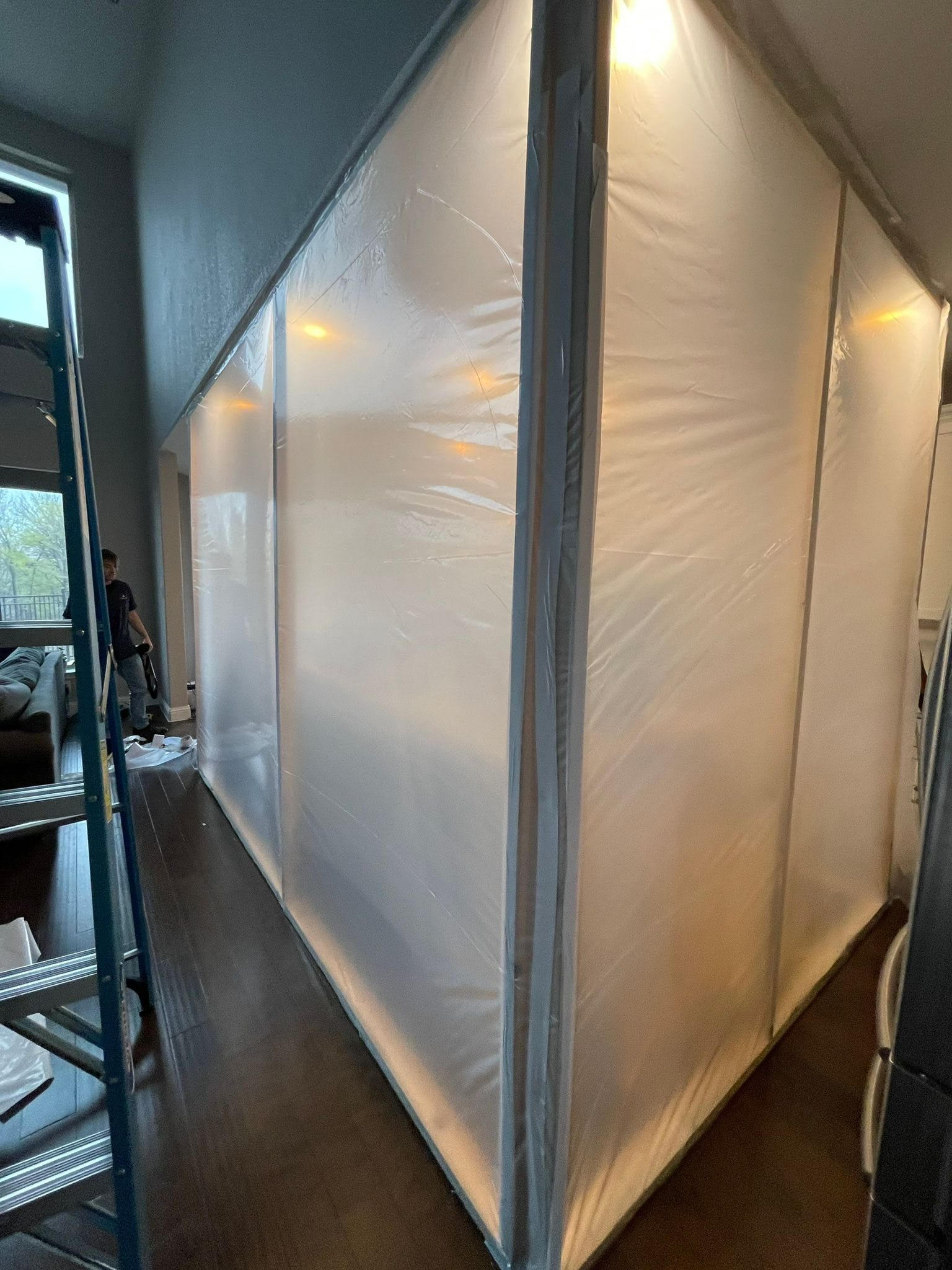
How Mold Remediation Works in Connecticut
Connecticut does not require a state-mandated mold remediation license. We follow IICRC S520 protocols and EPA guidance, the national industry standard, and recommend an independent assessor for pre- and post-remediation documentation.
Inspection and Quote
We perform a visual inspection of the affected area, identify the moisture source, and provide a detailed scope and estimate. For documentation purposes, we can recommend independent mold assessors who perform pre- and post-remediation testing.
Source Repair
The source of the moisture must be addressed before remediation begins, otherwise the mold will return. We can handle the repair ourselves or coordinate with plumbers or roofers to get it resolved.
Containment and Remediation
We set up containment barriers and negative air pressure systems to isolate the affected area. HEPA-filtered air scrubbers capture airborne spores. Contaminated materials are safely removed following IICRC S520 protocols, and all surfaces are treated with professional-grade antimicrobial agents.
Restoration
If an independent assessor was engaged, they return to perform clearance testing and verify successful remediation. We then restore the space, including drywall, insulation, and paint, back to pre-loss condition.
Why Danbury Chooses KPM
Local expertise, certified technicians, and a commitment to getting you back to normal.

IICRC S520 Certified
Our technicians follow IICRC S520 mold remediation protocols and EPA guidance, the national industry standard for containment, HEPA filtration, removal, and antimicrobial treatment.
IICRC AMRT Certified
Our technicians hold Applied Microbial Remediation Technician (AMRT) certifications and follow all IICRC S520 protocols.
We Handle the Rebuild
After your assessor confirms clearance, our in-house crews restore drywall, insulation, painting, and any other damage from the remediation process.
Locally Owned Since 2017
We're your neighbors. KPM is locally owned and operated across the Hudson Valley and Capital Region with 9 offices.
Need mold remediation in Danbury?
Get in touch to schedule an assessment. We'll respond promptly with next steps for your Danbury property.