
Mold Remediation in Norwalk
Mold in Your Norwalk Property?
From South Norwalk's converted iron-works lofts on Washington Street to the coastal cottages of Rowayton, East Norwalk near Calf Pasture Beach, and the hillside Victorians of Golden Hill, Norwalk's housing sits within reach of the Norwalk River, the Five Mile River, and Long Island Sound. That harbor and river moisture, paired with the city's roughly one-in-five homes built before 1940, creates the year-round damp conditions that feed hidden mold. KPM Restoration follows IICRC S520 mold remediation protocols and EPA guidance for properties from the Norwalk Green and Wall Street downtown out to Silvermine, Cranbury, and Wolfpit. Our technicians are IICRC certified and follow OSHA-compliant safety protocols. See our full restoration services in Norwalk.
Call Now (914) 521-4110Get Help Now
Trusted in Norwalk & Beyond
Real, verified 5-star reviews from homeowners and businesses we've served.
“I have used KPM personally for fire damage from a chimney Fire and Water damage from broken pipes on two different occasions in Dutchess County. They Cleaned all the smoke stains and got rid of the smoke smell throughout the entire house. For the water damage they removed carpets and sheet rock. They treated for mold, cleaned everything up perfectly, used driers and dehumidifiers, tested for any residual moisture and best of all they delt with the insurance company and adjuster to get what I deserved to replace everything. The entire KPM team from the start were all respectful, extremely professional, very knowledgeable, caring, polite and the men were absolutely gentleman to my family and I. I will never forget this and will highly recommend them to anyone. Commercial and residential. Thank you KPM”
rich wisseman
“When my basement decided to become a pond, KPM came in like the cleanup Avengers. They were quick to show up, professional and they got everything cleaned up and dried out before I could fully spiral. Hoping I won’t ever have to call again but they did a great job!”
Kate Garofalo
“Great team!! Wonderful to work with. They did a great job!!”
Caylee Frost
“I couldn’t get a company to come out during a storm that we had in Elmsford house. Josh and Joe were so amazing to work with Ty guys”
joshua diego
“Amazing company to work with. Honestly the best guys. I had a awful flood and called them”
Mackenzie Elston
“could not get a call back from any company and I finally got in touch with kpm restoration and they helped me with my sewage cleanup.”
Anthony Johnson
“KPM restoration was so helpful at my water damaged house in Elmsford. Jim and tom cleaned it and helped me off a ledge !!”
Jacob Tomlin
“I can’t recommend KPM Restoration enough! I had a mold issue in my home, and their team handled everything with professionalism and care. They arrived on time, explained the process clearly, and made what felt like a stressful situation completely manageable. Every corner of the problem was addressed, and they left my home clean and safe. It’s clear they genuinely care about their clients and the work they do. If you need mold remediation—or any restoration work—KPM is the team to trust!”
Delia Mahaffey
What to Know
Understanding Mold Growth
Connecticut Mold Remediation: IICRC and EPA Standards
Connecticut does not have a state-mandated mold remediation license. We follow the national industry standard (IICRC S520) and EPA mold remediation guidance, which together define proper protocols for containment, HEPA filtration, removal of affected materials, antimicrobial treatment, and post-remediation verification. Our technicians hold IICRC certifications including WRT (Water Damage Restoration) and AMRT (Applied Microbial Remediation). For documentation purposes, such as a home sale or insurance claim, we recommend hiring an independent mold inspector. We're happy to refer one and coordinate the work.
Mold in Norwalk's Pre-War Homes and SoNo Lofts
Much of Norwalk's built environment is a post-1779 reconstruction after the British burning, and the city carries a deep stock of 19th-century mill-worker cottages, triple-deckers, and worker housing on Ann, Water, Washington, Haviland, and Meadow Streets in South Norwalk, along with the Victorian and Second Empire homes on Golden Hill. These older properties often have rubble, fieldstone, or stone-wall basements with minimal waterproofing that wick moisture year-round, plus original plaster walls that hide growth behind them. SoNo's converted industrial lofts present a different challenge: the Maritime Aquarium itself occupies a former 1860s iron works, and the surrounding masonry shells now fitted with modern mechanicals trap moisture in ways the original buildings were never designed for. We use thermal imaging and moisture meters to find hidden colonies.
Harbor and Sound-Shore Humidity
Properties along Norwalk Harbor, the peninsulas of Wilson Point, Village Creek, and Marvin Beach, Rowayton along the Five Mile River, and the East Norwalk shoreline toward Calf Pasture Beach face higher year-round humidity from harbor and Long Island Sound exposure. Hurricane Sandy pushed roughly a five-foot surge into harbor-adjacent streets in 2012, and the low-lying SoNo and Shorefront Park blocks remain among the city's most chronic damp zones. Combined with crawlspaces, finished lower levels, and HVAC systems that were not specified for marine conditions, the result is ideal for hidden mold in finished basements, behind built-ins, and inside wall cavities. We scope these losses with thermal imaging and moisture meters before any demo to make sure the remediation captures the full footprint.
Commercial Mold Along Connecticut Avenue and Downtown
Mold issues in Norwalk's commercial buildings often surface around HVAC equipment, behind chronic-leak walls, in tenant-improvement build-outs that trapped moisture, and in basement and mechanical-room spaces. The dense Connecticut Avenue commercial corridor, SoNo restaurants, and downtown professional offices all add pressure to resolve quickly when tenant complaints or indoor-air-quality concerns surface. We coordinate with property managers and assessors to scope, contain, and remediate with minimal disruption to operations.
After a Water Loss: Mold Prevention Window
Mold can begin colonizing wet materials in as little as 24 to 48 hours. The Norwalk River valley regularly rises after heavy rain, the same corridor that flooded catastrophically in 1955, and homes in Broad River near the Silvermine River junction, along the Five Mile River in West Norwalk, and across the low harbor streets of South Norwalk see repeated water intrusion. Whether the cause is a burst pipe in an older galvanized supply line, a sump pump failure, an appliance leak, or river and Sound-shore flooding, getting the structure dried and treated fast is what prevents a water job from turning into a mold job. If the water event is recent, our water damage restoration and mold teams coordinate so you are not managing two contractors.
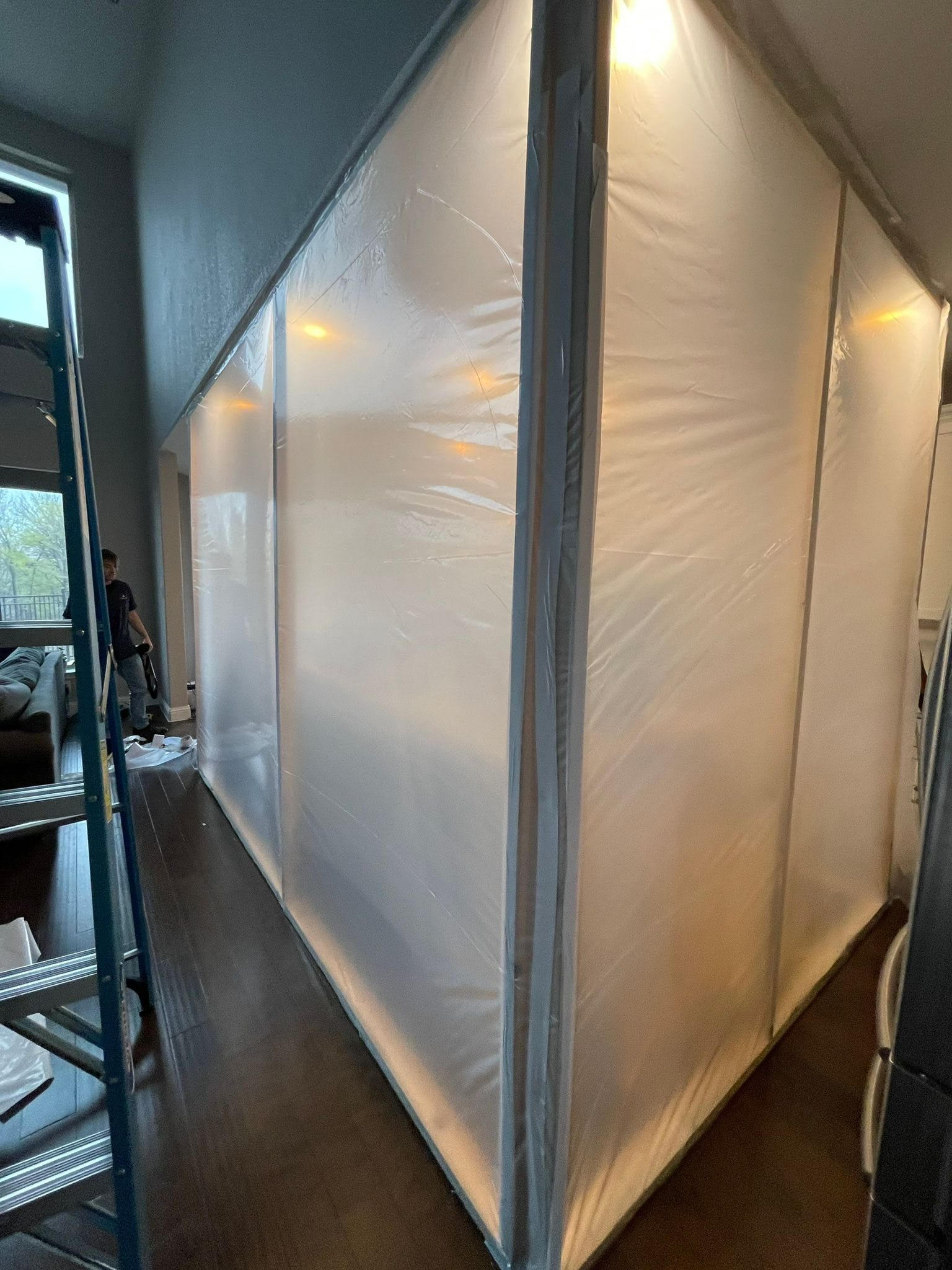
How Mold Remediation Works in Connecticut
Connecticut does not require a state-mandated mold remediation license. We follow IICRC S520 protocols and EPA guidance, the national industry standard, and recommend an independent assessor for pre- and post-remediation documentation.
Inspection and Quote
We perform a visual inspection of the affected area, identify the moisture source, and provide a detailed scope and estimate. For documentation purposes, we can recommend independent mold assessors who perform pre- and post-remediation testing.
Source Repair
The source of the moisture must be addressed before remediation begins, otherwise the mold will return. We can handle the repair ourselves or coordinate with plumbers or roofers to get it resolved.
Containment and Remediation
We set up containment barriers and negative air pressure systems to isolate the affected area. HEPA-filtered air scrubbers capture airborne spores. Contaminated materials are safely removed following IICRC S520 protocols, and all surfaces are treated with professional-grade antimicrobial agents.
Restoration
If an independent assessor was engaged, they return to perform clearance testing and verify successful remediation. We then restore the space, including drywall, insulation, and paint, back to pre-loss condition.
Why Norwalk Chooses KPM
Local expertise, certified technicians, and a commitment to getting you back to normal.

IICRC S520 Certified
Our technicians follow IICRC S520 mold remediation protocols and EPA guidance, the national industry standard for containment, HEPA filtration, removal, and antimicrobial treatment.
IICRC AMRT Certified
Our technicians hold Applied Microbial Remediation Technician (AMRT) certifications and follow all IICRC S520 protocols.
We Handle the Rebuild
After your assessor confirms clearance, our in-house crews restore drywall, insulation, painting, and any other damage from the remediation process.
Locally Owned Since 2017
We're your neighbors. KPM is locally owned and operated across the Hudson Valley and Capital Region with 9 offices.
Need mold remediation in Norwalk?
Get in touch to schedule an assessment. We'll respond promptly with next steps for your Norwalk property.